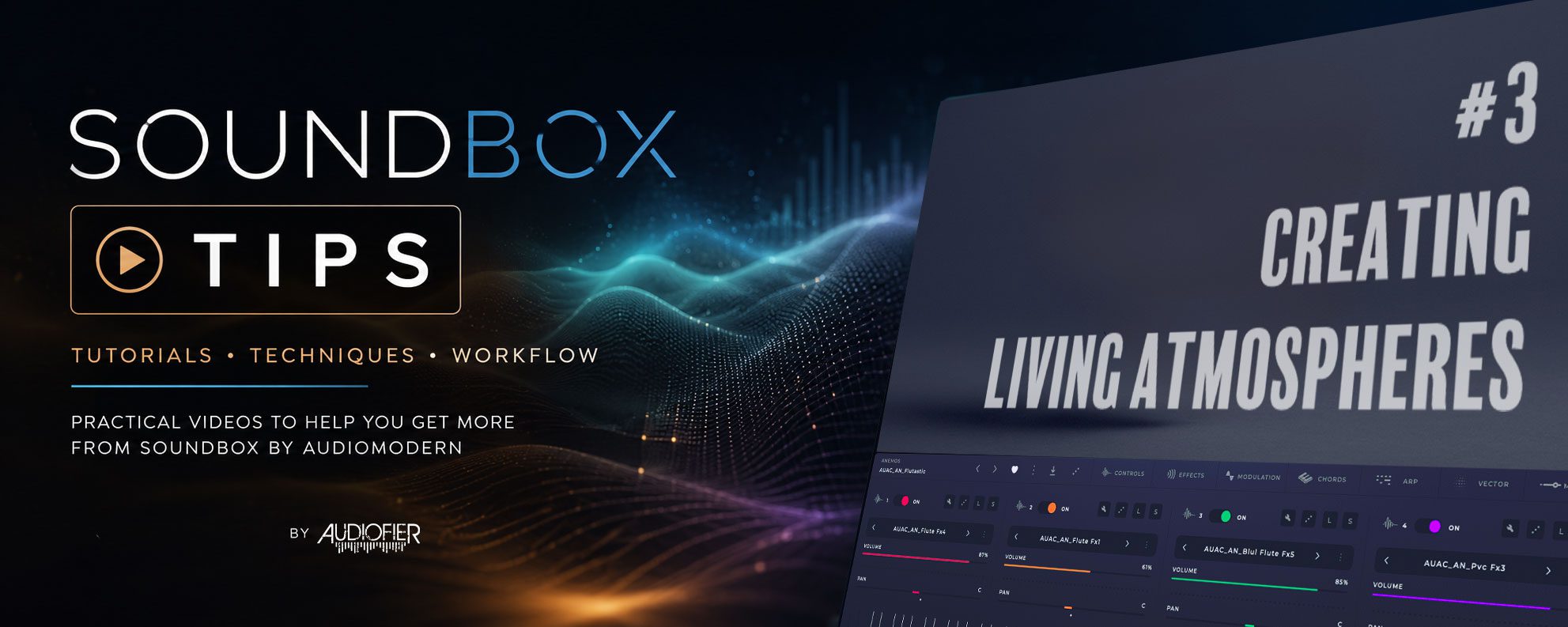
Soundbox Tips #3
Creating Living Atmospheres
What if a single held note could become an entire environment?
In the third episode of our Soundbox Tips series, we move beyond pads and melodic patches to explore how you can create living, evolving soundscapes inside Soundbox by Audiomodern—atmospheres where small sonic events appear, disappear, move around you and interact in ways that rarely feel exactly the same twice.
The secret isn’t complex synthesis or an enormous collection of samples. Instead, we’ll look at how a few carefully chosen sounds can be made to behave independently, creating the impression of a much more intricate and organic environment.
In this video you’ll discover:
How to approach atmospheric sound design as a collection of events rather than patterns.
A clever way to make simple layers interact without obvious repetition.
How movement, space and timing can make an atmosphere feel alive.
How a single layer can become a source of multiple, unpredictable sonic events.
Why sometimes a handful of simple sounds can produce a surprisingly complex soundscape.
We’ll build the atmosphere using a drone alongside wind, bells and breathy flute textures originally recorded for THORNS from Audiofier’s MICRON Series, gradually transforming them into a continuously changing environment.
If you create cinematic atmospheres, ambient textures, game soundscapes or evolving underscore, this technique can open up some very interesting possibilities inside Soundbox.
And if you’ve explored our ANEMOS Soundbox pack from the Acorn Series, you may recognise some of the thinking behind this approach. Similar ideas can be found throughout some of its atmospheric presets—simple elements interacting over time to create something much larger than the individual sounds.
Soundbox Tutorials & Tips
Welcome to the Audiofier Soundbox Tutorials & Tips hub—our growing collection of free videos dedicated to Soundbox by Audiomodern.
Whether you’re just getting started with Soundbox or you’re looking for new sound design techniques, workflow ideas, and creative programming tricks, these tutorials will help you get more from this powerful sampler and virtual instrument platform. From evolving pads and cinematic textures to arpeggiator techniques, layering, envelopes, effects, and creative patch building, each video focuses on practical ideas you can apply immediately to your own projects. Soundbox combines advanced sampling, powerful modulation, multiple layers, time-stretching, and flexible performance tools, making it an exceptional platform for modern composers, producers, and sound designers.
Many of the examples you’ll hear use Audiofier’s Acorn Series of Soundbox instruments. While these videos are useful for any Soundbox user, they also offer a behind-the-scenes look at some of the techniques and programming concepts that inspired many of our presets.
Our goal isn’t simply to explain individual features—we want to share creative approaches that help you design more expressive, inspiring and playable instruments.
New Soundbox tutorial videos will be added from time to time, so check back often for fresh tips, sound design ideas, workflow improvements, and creative inspiration.